Weekly AI use in tax research has nearly doubled
A year ago, a third of US tax professionals used AI for research every week. Now it's a clear majority. In a Blue J and CPA.com survey of more than 1,000 US tax professionals, 60% said they use AI for tax research at least weekly, up from 33% in 2025. One caveat: the mix of respondents changed from the prior year, so read the jump as a direction rather than a precise measurement.
The same survey found that 69% expect to move to value-based, hybrid or fixed-fee billing. That's the business consequence. When research that took an afternoon takes ten minutes, the billable hour stops describing the work, and firms start pricing the answer instead of the time.
Agents are earlier in the curve. Thomson Reuters' 2026 AI in Professional Services report, based on more than 1,500 respondents and released early this year, found that only 15% of organizations use agentic AI, with another 53% planning or considering it. Only 18% track the ROI of AI at all.
Put those together and you get a profession where most people use AI for research every week, few use agents, and fewer still measure what any of it is worth. That's the stage at which errors start showing up in front of judges.
What Clinco and the California OTA tell practitioners
They have. In Clinco, T.C. Memo. 2026-16, three of the four cases counsel cited were likely AI hallucinations. The Journal of Accountancy notes that the court stopped short of sanctions and that this appears to be the first Tax Court case on the issue. In July, the California Office of Tax Appeals addressed "hallucinated or fictitious citations" in an opinion for the first time, and it is considering issuing guidance, according to Bloomberg Tax.
Two things stand out to us. The first is how basic the failure was. Three of four citations were likely invented, and checking each one against a primary source would have taken minutes. Nobody needed a sophisticated review process to catch this. They needed any review process.
The second is that the absence of sanctions shouldn't reassure anyone. First cases are where a tribunal states the standard. The cases after that are where it enforces it. If we ran a tax practice, we would assume the next fabricated citation in a federal filing costs more than embarrassment.
The IRS OPR guidelines in plain English
In summer 2026, the IRS Office of Professional Responsibility, which administers Circular 230, issued "Introductory Guidelines for Responsible AI Use in Federal Tax Practice" (Issue 2026-19). Read as a whole, it says that nothing about your professional duties changed when you started using AI.
In practice, three points matter most.
Competence, diligence and confidentiality are unchanged. A tool doesn't lower the standard. It adds one more thing you're responsible for understanding.
You must verify what the AI produces. The guidelines name facts, citations and calculations. If a model computed a basis adjustment or cited a regulation, a practitioner checks it before it reaches a client or the IRS.
Client data can leak between matters. This is the warning we'd underline twice. A tool that remembers context, or a document index shared across clients, can surface one client's information while you're working on another's.
None of this is exotic. It's the standard that already applies to work a junior associate hands you. The difference is volume. An AI tool can produce in an afternoon what a junior produces in a month, so verification has to be built into the workflow. Good intentions don't scale to that volume.
Designing for defensibility: citations tiered by source authority
TaxFigure started from a brief with two halves: answer hard tax questions in minutes rather than hours, and be trusted enough for professional use. The second half is the hard part. In the system we built, a research coordinator breaks each question into parallel sub-tasks, specialized agents search statutes, regulations, case law and client documents at the same time, and a synthesis agent writes the answer with full citations. A six-tier citation system makes every answer professionally defensible.
The principle behind tiering is one every practitioner already works with: authorities don't weigh the same. The Internal Revenue Code sits above Treasury regulations. Regulations carry more weight than IRS guidance such as revenue rulings. A private letter ruling can't be cited as precedent. A treatise or a firm newsletter can help you find authority, but it isn't authority. A research tool that presents a revenue ruling, a Tax Court memo and a blog post as interchangeable "sources" is giving you less than a first-year associate would.
Whatever product you use, including the ones we build, these are the properties we'd insist on.
Every citation resolves to a source the system actually retrieved. The model shouldn't be able to cite anything outside its retrieved set. If a case name appears in the answer and not in the retrieval log, that's a defect, and the answer should fail before a person sees it. That one check addresses the failure in Clinco directly.
Each citation carries its authority level. Code section, final regulation, case and court, ruling, secondary source. A reviewer should see at a glance whether a conclusion rests on the statute or on commentary.
Quotes and holdings are checked against the text. Retrieving the right case isn't enough if the answer paraphrases it into saying something it doesn't. A verification pass that compares each quoted or summarized holding with the retrieved passage catches errors that look correct at first read.
The answer admits its gaps. When authority is thin or conflicting, the tool should say so plainly instead of smoothing it into confident prose.
Client confidentiality when AI touches tax documents
Tax files are dense with the data you least want to leak: Social Security numbers, income, dependents, account details. TaxFigure treats W-2s, 1099s, K-1s and prior-year returns as first-class agent tools, with a GPU-accelerated intake service that turns scanned forms into structured, searchable knowledge. That's valuable precisely because it brings client documents into the research loop, and it's also why confidentiality has to be designed in from the start.
Two patterns answer the OPR warning directly.
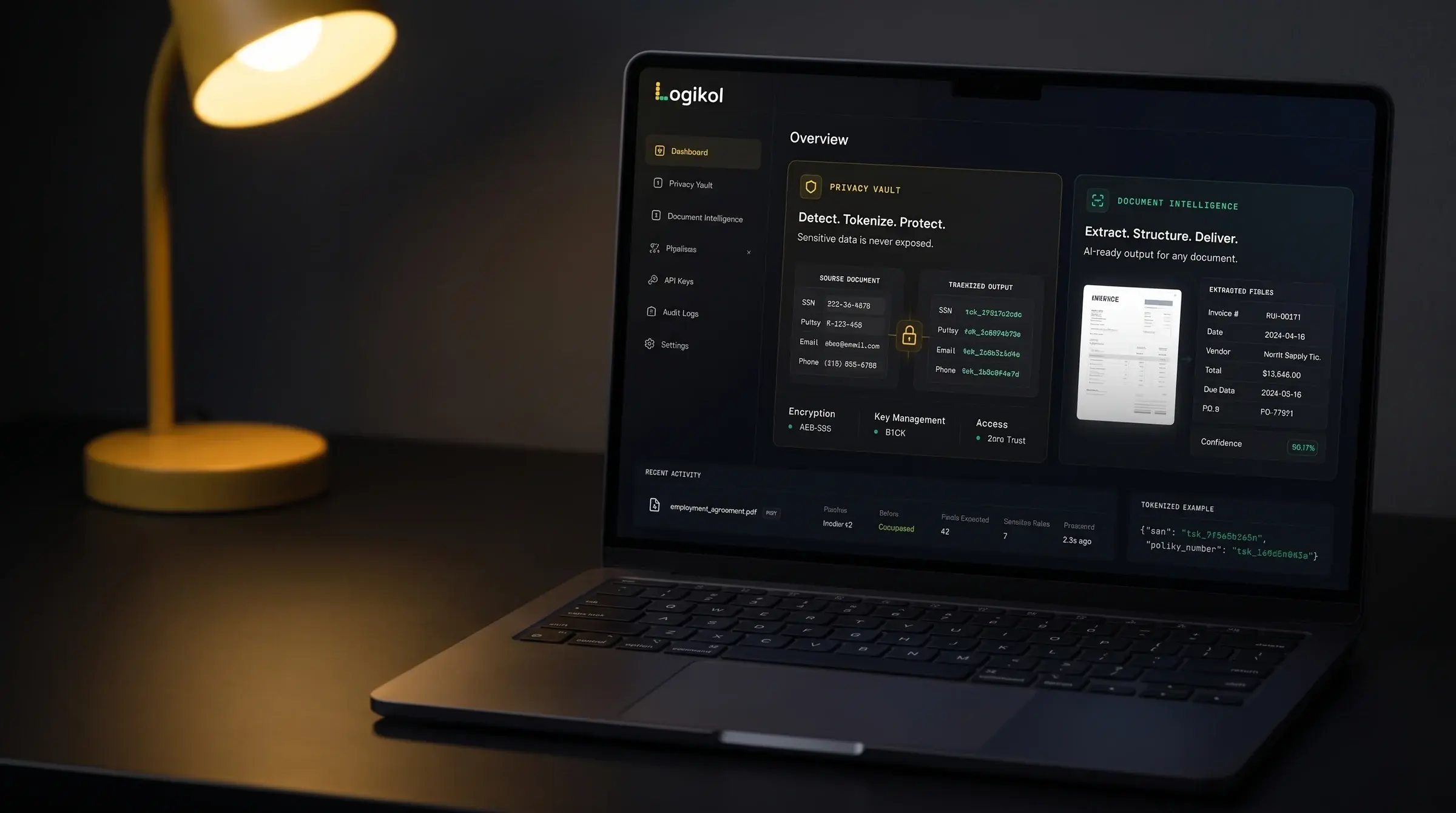
The first is tokenization before the model sees anything. On Logikol, we built a privacy vault that detects and tokenizes PII before it leaves the customer's systems, and an LLM gateway that proxies prompts to any provider while scrubbing identifiers. The model can reason about "Taxpayer A's K-1 income" without ever receiving an SSN. Logikol deploys in managed cloud, a single-tenant VPC, or fully air-gapped environments, which matters for firms whose engagement letters restrict where client data may go.
The second is isolation by matter. Each client engagement gets its own retrieval namespace, its own document store and its own conversation memory, and access is checked at retrieval time, not only in the interface. A single shared index is the easiest way to build the leak the OPR is warning about, because it's also the easiest thing to build.
Questions to ask before you adopt an AI research tool
- Can every citation in an answer be traced to a document the system retrieved, and can we see that trail?
- Does the tool distinguish primary authority from secondary sources in the answer itself?
- What happens when it can't find authority? Does it say so, or answer anyway?
- Where does client data go, which model providers see it, and is PII removed before they do?
- How are clients and matters separated in storage, retrieval and memory?
- Can it run in our own cloud or infrastructure if a client requires it?
- What will we measure to know it's working? Thomson Reuters found only 18% of organizations track AI ROI.
If you're building a research tool or choosing one and want to pressure-test its citation design against cases like Clinco, we're glad to talk it through.
Sources
- Blue J and CPA.com survey finds AI adoption among tax firms has nearly doubled in one year, CPA Practice Advisor, June 23, 2026
- Issue 2026-19: Introductory Guidelines for Responsible AI Use in Federal Tax Practice, IRS Office of Professional Responsibility, issued in summer 2026
- A recipe for sanctions: AI-hallucinated citations in tax, Journal of Accountancy, September 1, 2026
- California tax tribunal mulls AI rules as fake citations surface, Bloomberg Tax, July 24, 2026
- 2026 AI in Professional Services report, Thomson Reuters Institute, early 2026